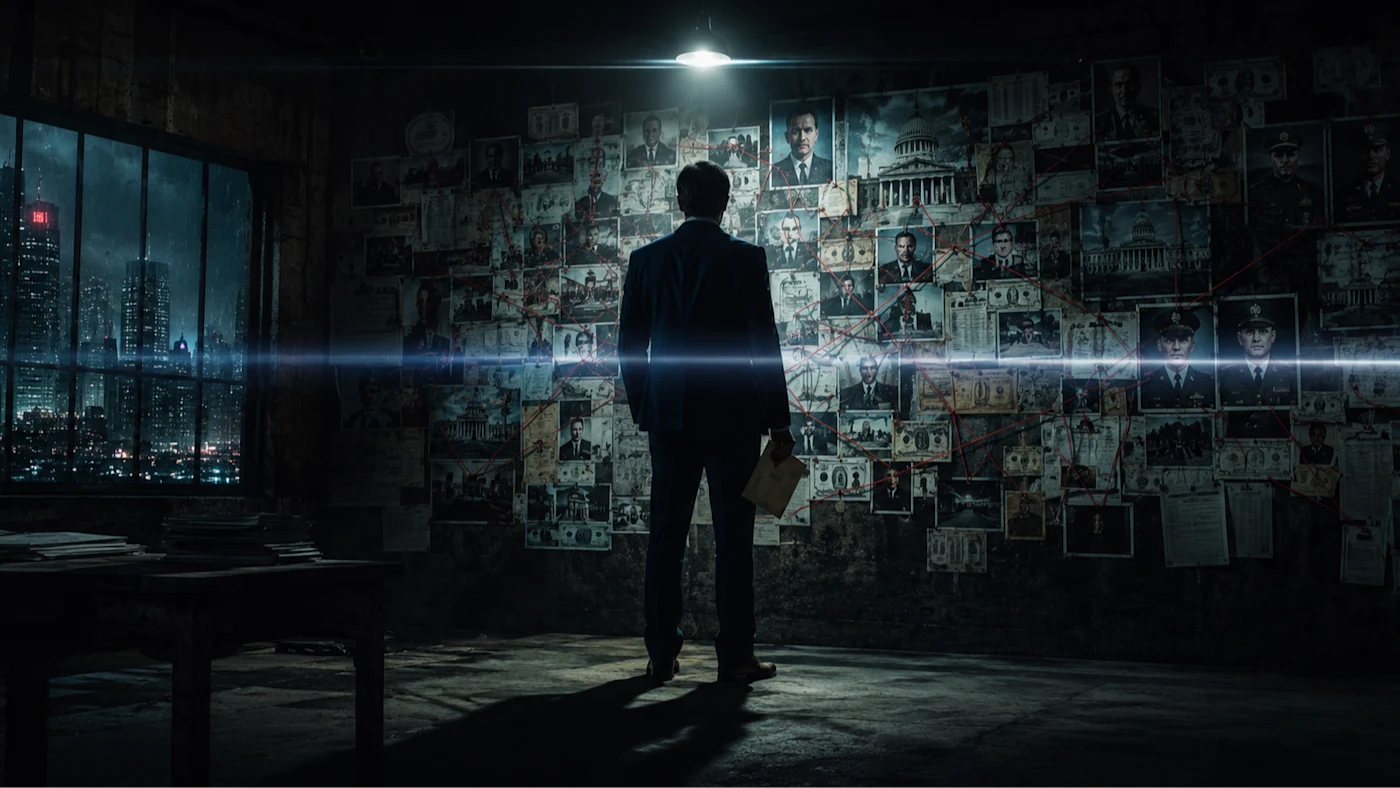
You've Been Lied to About the Web of Deceit
The Web of Deceit isn't fiction — it's the pattern hiding inside every system you trust. A banker, a buried will, a network that kills to stay invisible.
By the time you finish reading this, three things will be true. You weren't supposed to find this page. You weren't supposed to know what it leads to. And someone, somewhere, is already taking notes.
The Web of Deceit is not a brand. It is not a marketing line. It is a name given to a pattern — the kind that surfaces when a banker from New York lands in Mumbai expecting paperwork and finds a fortune that smells, in his own words, complicated. The kind that turns a probate file into a death sentence. The kind that begins with one signature and ends with bodies the news never names.
You came here looking for an Indian crime thriller. You'll leave wondering if you stumbled into something stranger — a fan-built universe where every page is a confession someone tried to bury.
This is the first post. The doorway. Step through it with care.
The Inheritance Was Never the Point
Vivek Vaidyanath flew into India for a funeral. He stayed for a war.
Shashank Gupta's death looked, on the surface, like the kind of administrative grief any expat dreads — a flight booked in haste, a lawyer's office with cold tea, a will that needed an executor. Nowroji, the lawyer, spoke as though reading evidence aloud. Navazbai, his wife, asked questions a witness would recognise. Vivek told himself he was paranoid. He was not paranoid.
The estate was a story already in motion. The fortune wasn't a fortune — it was a key. And once Vivek's signature went on the executor's line, his name entered a ledger that the men who wrote it had killed three people to keep clean.
Crime fiction, traditionally, gives you a villain. The Web of Deceit gives you a network. There is no master criminal in a leather chair stroking a cat. There is a cluster — a constellation of bank accounts, shell companies, political donations, mid-level officers, and dead men's signatures. You don't fight a constellation. You map it, and you pray you map it faster than it maps you.
Once your name enters the network, it never really leaves.
That sentence is the spine of the Web of Deceit trilogy. It is also, if you are honest with yourself, the reason you are still scrolling.
The STF analytics team will tell you what Vivek learned within seventy-two hours of landing: a will is a tracking device. A signature is a beacon. An inheritance is rarely about who is being given something. It is about who is being marked.
The question is no longer what Shashank Gupta left behind. The question is who decided he had to die for someone else to inherit it.
What Every Indian Crime Thriller Got Wrong
For decades, the Indian crime thriller built itself around the same architecture. A maverick cop. A monstrous gangster. A city as a backdrop. A climactic encounter on a rooftop, in a rain-slicked alley, inside a warehouse with too many shadows.
The Web of Deceit doesn't believe in that architecture. The Web of Deceit watched it work for forty years and catalogued every assumption it left exposed.
Here is the first assumption: that criminals act like individuals. They do not. They act like organisms. Trisha — the woman whose name surfaces later, in the third book, the one with the cold smile and the colder ledger — is not a villain in the classical sense. She is a node. Cut her out and the network reroutes. Cut out the network and you find yourself staring at the people who built it. And those people, you will discover, do not wear the clothes you were taught to suspect.
Here is the second assumption: that crime is loud. It is not. The Web of Deceit operates in spreadsheets, in offshore transfers, in cluster maps drawn on whiteboards by analysts who do not own guns. There are gunshots in this universe. There are also rooms where the only sound is a kettle, and the only weapon is a pivot table. The kettle room is the one that ends careers.
We're not chasing criminals anymore. We're chasing patterns.
Ramakant said it to his team after the second assassination attempt. He was not being poetic. He was describing a methodology that has rewritten how this Indian crime thriller reads — and, you will start to notice, how you read everything else.
This is the Indian crime thriller stripped of its disguises. No swagger. No saviour. A banker, a team of analysts, and a city that keeps pretending it doesn't know what's happening inside its own bones.
Stay with that thought. It gets worse before it gets clearer.
Hidden Networks Don't Hide From the Lazy. They Hide From the Honest.
There is a moment in the second book — the diehards will know it without being told the page — when an STF officer stares at a cluster map and goes silent for forty seconds. He has realised that one of the names on the network belongs to someone he had dinner with the week before.
This is what the Web of Deceit understands that lesser stories do not. Hidden networks are not hidden from the indifferent. The indifferent never look. Hidden networks hide from the people most likely to expose them — the honest, the loyal, the ones who would rather not believe what the data is showing them.
The Web of Deceit turns this into a method. The team learns to mistrust the obvious. They learn that the weak link in any criminal ecosystem is rarely the man at the bottom of the food chain. It is the person three layers above him, holding a job that looks too respectable to question. They learn that a politician's smile is a data point. That a banker's lunch reservation is a coordinate. That a courier's route, plotted over six months, draws a shape no honest economy would tolerate.
The shadows don't hide them. The system does.
If that line lands too close to home, that is the point. The Web of Deceit was built for the reader who suspects, in the part of themselves they do not write down, that the news has stopped explaining anything. That the headlines are summaries of decisions made elsewhere. That the men who appear at the top of the page are rarely the men who wrote it.
Vivek did not want to believe this. He wanted to fly back to New York. He wanted his life to resume. Instead, he learned to read offshore transactions the way a doctor reads bloodwork — looking for what the body is concealing from itself.
[LINK: The Vivek Vaidyanath Files — Why a Banker Makes a Better Detective Than a Cop]
You came here to be entertained. You will leave a different kind of reader. The kind who does not look at a financial scandal in the morning paper without asking, under your breath, what cluster it belongs to.
The Conspiracy Thriller That Refuses to End
Most stories in the conspiracy thriller genre offer you closure. The killer is named. The mastermind is shot. The credits roll. You go to sleep believing that order, however bruised, has been restored.
The Web of Deceit will not give you that. Not because the universe is cruel, but because it is honest. The third book ends with a confrontation, yes. The countdown to December 25 resolves. Trisha steps into the light. The masks come off, in spectacular fashion, and certain readers will reread the final fifty pages three times before they accept what they have been shown.
But the universe does not close.
A trilogy ends. A pattern does not. That is the architectural genius of what Mani Raman Subra has built, and it is the reason the Web of Deceit has already outgrown its three books. There are characters who survived who should not have. There are ledgers that were never reconciled. There are names that flickered through one chapter, two chapters, and then vanished — and the diehard fans have a list of those names, and the list grows every month.
The real enemy isn't hidden in the shadows. It's embedded in the system.
That is the line that built the Web of Deceit. It is the line you will hear quoted in fan discussions, dissected in book clubs, and printed on the inside of paperback covers in the next edition. It is also the line that explains why one conspiracy thriller trilogy has become a living, breathing fictional world, expanding through fan theories, character backstories, lore essays, and posts like this one.
You are reading the first piece of that expansion. Every post that follows on the Web of Deceit Universe site will treat the books not as finished objects but as field reports — provisional, redacted, still being amended.
[LINK: The Mumbai Conspiracy Thriller Map — Every Location in the Web of Deceit, Decoded]
That is the promise. That is also the warning.
A Final Word You Were Not Meant to Read
You should not be here.
The Web of Deceit Universe is small, for now. The visitor logs are short. The names on the subscriber list could fit in a single folder, and if you join it tonight, your name will be on the early pages — which is either a privilege or a problem, depending on who eventually reads the file.
Subscribe before the next post drops. The next post names a character the books treated as dead. The post after that maps a connection between two real cities and one fictional account number — a connection that, if you are paying attention, will explain a news story you have been turning over in your head for months.
Walk away now and you will read the Web of Deceit trilogy and think it is fiction. Stay, and you will start to suspect it is not.
The web is not waiting. It is being woven. And once your name enters the network — well. You already know how that sentence ends.